
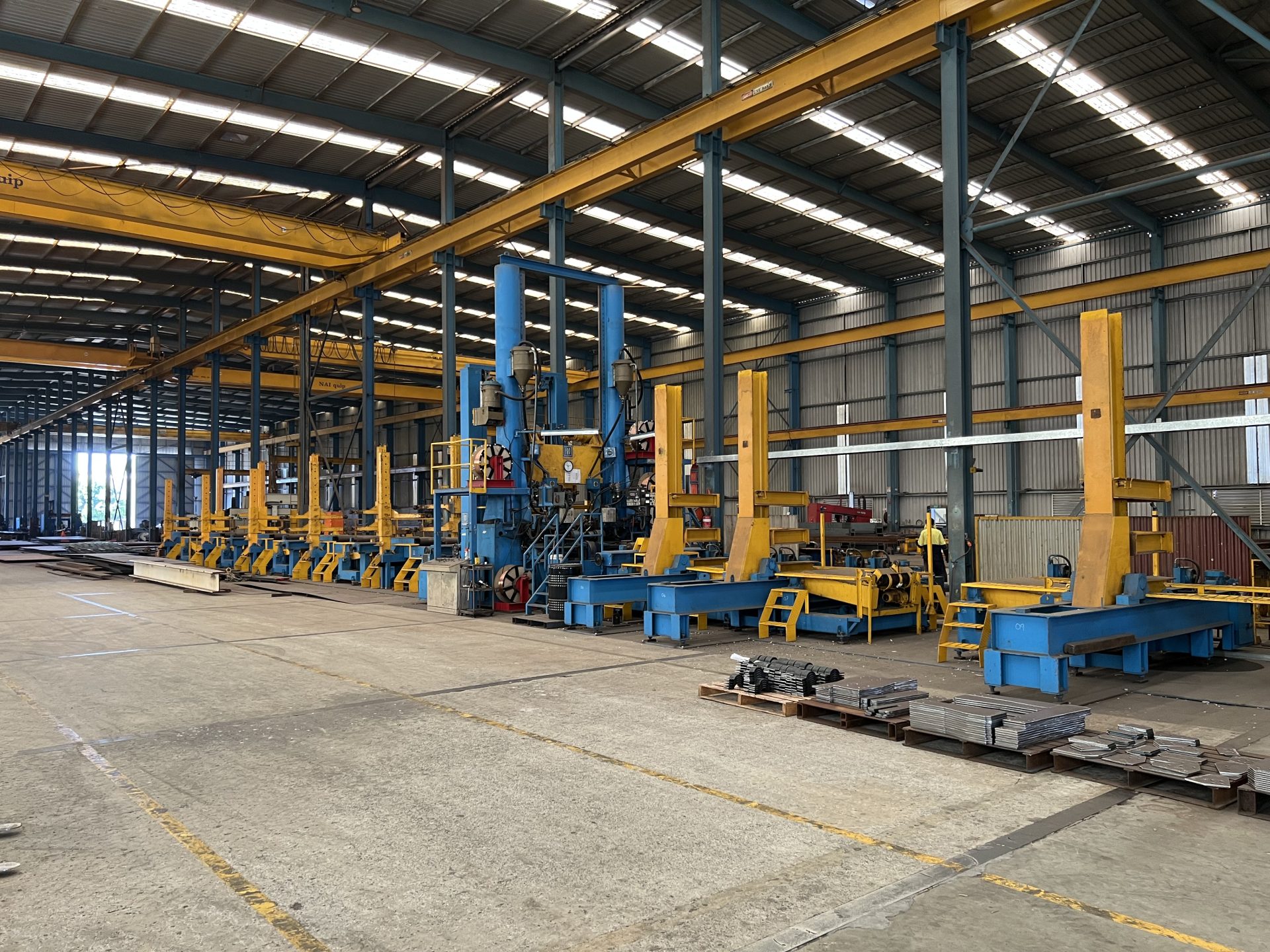
Custom beam manufacture

Engineered beyond standard sections

Fremantle Steel Group manufactures custom welded beams and structural sections to project requirements, giving engineers and contractors design freedom that standard rolled sections cannot. Flange and web dimensions, plate grade, depth and length are set to suit load, span, constructability, transport and erection, so a member can be optimised rather than rounded up to the nearest rolled size.

The Jandakot beam plant produces welded I-beams to 4 metres web depth and 30 metres long, and up to 40 metres has been achieved, by automated submerged arc welding, with the same material traceability, dimensional checks and inspection records as the rest of the workshop. That is well beyond the standard welded beam range, which stops at 1.2 metres deep, so deep plate girders and transfer beams can be made to the section the engineer designs. Typical products are plate girders for bridges, heavy transfer beams, built-up columns and special sections for infrastructure, transport, defence, commercial and industrial projects.

Because the sections are made in Western Australia, lead times, freight and quality risk stay local, and the beams move straight into fabrication, pre-assembly and delivery on the same site.

Your ability to overcome the steep learning curve required to master the art of fabricating deep plate girders is surely time and effort well spent.

Neil Cumming Project Engineer Fluor Australia
FAQs

Common questions

What is custom beam manufacturing?

Making a structural section by welding plates together rather than using a hot-rolled section from a mill. The web and flanges are cut from plate to the sizes the design needs, then joined by automated submerged arc welding. The result is a beam, girder or column with exactly the depth, flange width, thickness and length the project calls for.

When should custom welded beams be used instead of standard sections?

When the nearest rolled section is too heavy, too shallow, too short or not made at all: long spans, deep transfer beams, plate girders for bridges, members with service penetrations, tapered or variable-depth beams, and columns carrying unusual loads. Where a rolled section would be heavier than the design needs, a welded section sized to the load can reduce steel weight, with potential flow-on savings in transport and craneage; whether it does depends on the design.

What types of custom beams can Fremantle Steel Group manufacture?

Welded I-beams and columns to 4 metres web depth and 30 metres long as standard, with members to 40 metres achieved; plate girders, built-up and asymmetric sections, tapered and variable-depth beams, and heavy transfer beams. Larger or non-standard requirements are quoted case by case.

What industries commonly use custom beam solutions?

Bridge and transport infrastructure most of all, followed by commercial and industrial buildings with long spans or transfer structures, process plants, and defence facilities. Fremantle Steel has fabricated deep plate girders for bridge work and welded sections for the Perth Airport Pedestrian Link Skybridge and the Matagarup pedestrian bridge.

Can beams be manufactured to specific engineering requirements?

Yes. Sections are made to the engineer’s drawings and specification, with plate certificates, weld records, dimensional verification and inspection reports supplied with the delivery. Welding is to AS/NZS 1554 under an AS/NZS ISO 3834 Part 2 certified system.

How early should engineers engage Fremantle Steel Group during design?

During concept design, before sections are fixed. At that stage we can advise on plate availability, weldable geometry, transport length and weight limits, and where a welded section saves weight over a rolled one. We provide section data and manufacturing limits to engineers on request.